
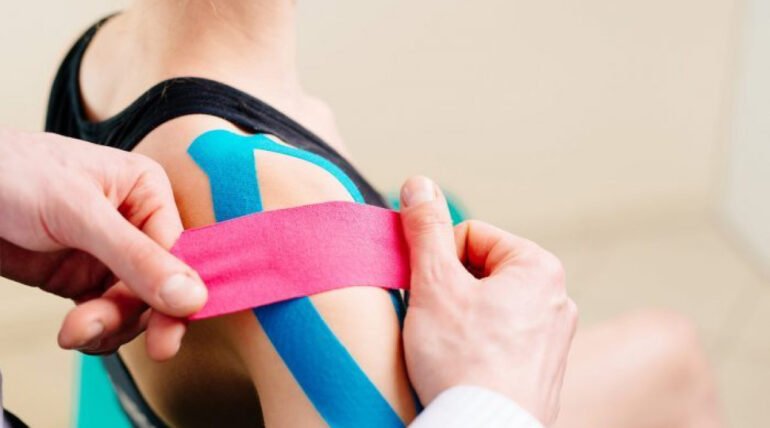
Chronic lateral epicondylitis (commonly known as “tennis elbow”) is a repetitive-strain injury of the forearm extensor origin that causes pain and limits function. This article presents evidence for the use of kinesiotaping (KT) combined with exercise and activity modification to reduce pain, improve strength and function, and enhance quality of life in patients with chronic lateral epicondylitis.
Introduction
Lateral epicondylitis (LE) affects individuals whose repetitive hand/wrist motions stress the extensor tendons at the lateral elbow, causing micro-trauma, tendon degeneration, and pain. It significantly disrupts daily activities and work productivity. While many treatments exist (e.g., physiotherapy, injections, splints), less invasive, low-cost options such as kinesiotaping have gained interest. KT is an elastic therapeutic tape applied to the skin that claims to improve proprioception, reduce muscle strain, assist lymphatic drainage, and support healing without restricting motion.
Methods
In the referenced randomized, sham-controlled, single-blind study, 42 patients with chronic LE (mean age ~44.5 years) were randomized into two groups: one received genuine kinesiotaping using an “epidermis-dermis-fascia (EDF)” plus muscle inhibition technique, the other received a visually similar sham tape (non-elastic medical cloth tape) over six applications across three weeks. Both groups were given identical home-based exercise programs (stretching and strengthening) plus activity modification advice. Outcomes were assessed at baseline, after 3 weeks of treatment, and at a 7-week follow-up, using pain scales (VAS), functional questionnaires (PRTEE, DASH), grip strength, quality of life (SF-36), and patient satisfaction.
Results
Both groups improved compared to baseline across all outcome measures. However, the KT group demonstrated significantly greater improvements at both the 3-week and 7-week time points compared to the sham group in most measures (pain, function, disability, grip strength, quality of life). Patient satisfaction was much higher in the KT group (~86% “excellent/good” vs ~30% in the sham group). No adverse effects from KT were reported.
Discussion
The findings suggest that kinesiotaping using the combined EDF and muscle inhibition technique is an effective adjunct for chronic LE, above and beyond exercise and activity modification alone. The non-restrictive nature of KT may allow greater movement with less pain, promoting function. The use of a sham-controlled design strengthens the evidence for a specific KT effect rather than just placebo. Limitations include a single-centre design, relatively small sample size, short follow-up, and no true “exercise-only” control arm.
Conclusion
Kinesiotaping appears to be a safe, cost-effective adjunctive treatment for patients with chronic lateral epicondylitis, when used alongside exercise and activity modification. It offers meaningful improvements in pain, function, and quality of life with high patient satisfaction. Future research should include longer follow-ups, larger multi-centre samples, and a true exercise-only control arm to further validate the findings.
Moving the goalposts sorry i was triple muted, so what do you feel you would bring to the table if you were hired for this position. A better understanding
Neque porro est qui dolorem ipsum quia quaed inventor veritatis et quasi architecto beatae vitae dicta sunt explicabo. Aelltes port lacus quis enim var